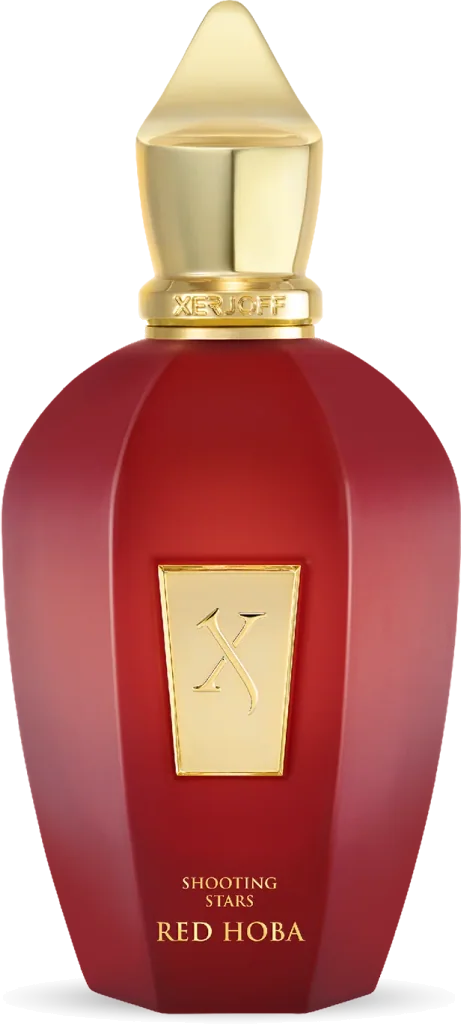
What Does Xerjoff Red Hoba Smell Like?
Red Hoba arrived in 2014 as part of Xerjoff’s Shooting Stars collection, and unlike the sweeter Naxos or Alexandria II from the same house, it leans dark and resinous. The opening is all heat: cardamom and cinnamon land together in the first minutes, with bergamot adding just enough citrus lift to keep the spice from turning flat. That bergamot fades fast. Community consensus agrees the citrus phase lasts roughly 15 to 20 minutes before the heart takes over.
From there, incense becomes the main character. Orris brings a cool, almost mineral powderiness underneath it, jasmine stays austere rather than pretty, and patchouli adds an earthy anchor. By the second hour the base asserts itself: guaiac wood contributes a gentle smoke, papyrus a dry papery woodiness, cashmeran a soft musky warmth, and labdanum a rich amber resin. Castoreum is the note people talk about. It gives the late drydown a leathery, faintly animalic quality that some wearers find magnetic and others find unsettling. Overall, Red Hoba reads warm spicy, woody and smoky, with only moderate sweetness.
Performance
This is one of the stronger performers in Xerjoff’s catalog by user consensus. Most reports put longevity between 8 and 12 hours, with the fragrance still detectable on fabric the next morning in cold weather. Projection is strong for the first two hours, loud enough to leave a trail, then pulls back to a close-wearing resinous glow for the rest of the day. Two or three sprays are plenty; four or more can fill a room. Fall and winter amplify everything good here, while heat pushes the spice and castoreum into territory many find too much.
Best Clone Or Alternative
The clearest affordable option is Dua Meteorite Of Fire, an explicit inspired-by recreation of Red Hoba with an identical 13-note list. It ships as a 34ml extrait-strength blend at $36, against $411 for 100ml of the original at Xerjoff’s own store. For a fraction of that price you get the same cardamom, cinnamon, incense, papyrus and castoreum architecture.
The tradeoffs matter, though. Dua bottles are small and the brand sells out regularly, including this one at times, so availability is never guaranteed. Extrait concentration makes the Dua version feel denser and slightly less airy than the original. The Xerjoff also blends more smoothly, especially through the transition from spice to incense, where the clone can show its seams. One more wrinkle: discount retailers have carried the original for well under its official price, sometimes near $175, so check gray-market listings before paying retail. If the original is available discounted and the Dua is out of stock, the value gap narrows considerably.
When To Wear It
Red Hoba is built for cold air and evening light. It fits fall and winter days, nights out, formal occasions and special dinners where a bold scent reads as intentional rather than careless. Spring works on genuinely cool days. Summer and hot offices do not. This is not a casual daytime signature unless your environment tolerates heavy fragrance.
Who Should Buy It
If you already enjoy smoky-spicy ambers and fragrances with an animalic edge, Red Hoba offers something distinctive even within a crowded niche lineup. It suits collectors who want one serious cold-weather statement piece and anyone drawn to incense-forward compositions that avoid the usual sweet amber template. Fans of bold scents like Amouage Interlude will recognize the ambition here.
Who Should Skip It
Pass if you want a safe office fragrance, a crowd pleaser, or something in the sweet, opulent style Xerjoff is better known for. The castoreum is genuinely polarizing, and community ratings around 3.5 out of 5 reflect that split. Anyone prone to headaches from heavy spice should sample on skin before committing, and nobody should blind buy this.
Final Verdict
Red Hoba is a well-made, strongly performing oddball that trades mass appeal for character. Its spice-to-smoke arc and castoreum drydown reward wearers who want complexity over likability, and its main flaws are situational: limited versatility, a high list price, and uncertain production status as the brand cycles stock. Sample it first, ideally through the inexpensive Dua Meteorite Of Fire when it is available, then decide whether the original’s polish justifies the upgrade. For the right wearer in the right season, it earns its place.