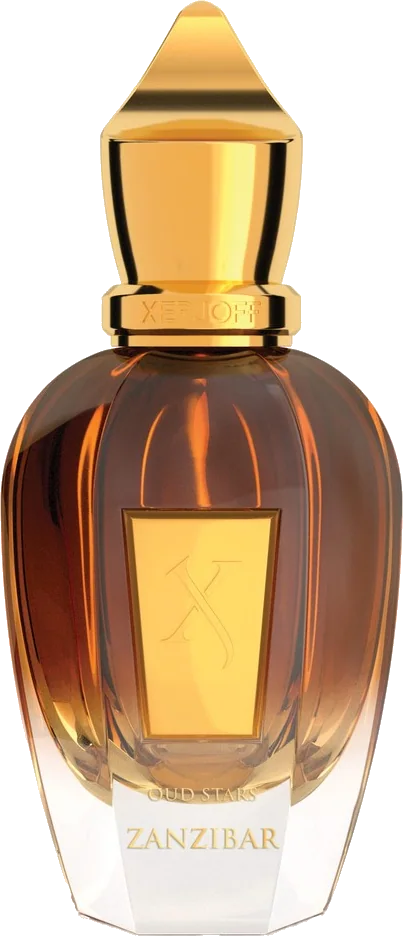
Xerjoff Najaf is one of the quieter casualties of the niche market’s discontinuation cycle. Launched in 2012 under the Oud Stars collection and later rebranded as Zanzibar, it has vanished from Xerjoff’s own site, and what survives on the secondary market trades at collector prices. That scarcity matters, because this is a genuinely distinctive composition: an oud fragrance built around osmanthus rather than rose or saffron, and one of the few releases where the flower, not the wood, drives the story.
What Does Xerjoff Najaf Smell Like?
The opening is dense and syrupy. Osmanthus arrives immediately with its signature apricot and preserved-fruit character, wrapped around a dark, slightly leathery agarwood. Green notes and cedar keep the top from turning fully sweet, but the first half hour is unmistakably rich. Community reviews split on the oud itself: some describe a tolerable, well-behaved wood that recedes after a few minutes, while others pick up a distinctly animalic, barnyard edge. Both readings show up often enough that sensitive noses should sample before committing.
By the heart, patchouli and osmanthus settle into something creamier, almost buttery, with a faint medicinal thread running through it. Reviewers regularly invoke Nasomatto Pardon for its chocolate-leaning patchouli, or Maison Mona di Orio’s Oudh Osmanthus for the same floral-over-agarwood pairing. The drydown moves toward tobacco leaf, sandalwood, musk, tonka bean, and vanilla, warming everything up considerably. Late in the wear it reads as a smooth woody-tobacco scent with just enough sweetness left to stay interesting.
Performance
Parfumo users rate longevity at 8.7 out of 10 and sillage at 8.1, which matches the wider consensus: seven to ten hours of wear with moderate projection. The first two to three hours are the loudest, projecting clearly at application before pulling back to a closer aura. A recurring observation is that the composition sheds some of its opulence around the three hour mark and settles into base notes earlier than expected. Even then it rarely disappears entirely. It behaves like an extrait-strength formula despite wearing the eau de parfum label, so two or three sprays are usually plenty.
Best Clone Or Alternative
Dua Baniqia is the practical route. The Dua Brand lists it openly as inspired by Najaf, and the note list mirrors the original almost exactly: tobacco, osmanthus, agarwood, sandalwood, patchouli, cedar, green notes, musk, tonka bean, and vanilla. It sells as a 34 ml extrait at 33.33% concentration for $36, against roughly $690 for a sealed 50 ml bottle of new-old-stock Najaf on the resale market.
Similarity runs around 85 percent because the whole identity rests on that osmanthus and agarwood pairing, which Dua reproduces faithfully. Where the original still wins is refinement. Experienced reviewers consistently praise Najaf’s oud quality and how seamlessly the fruit and wood integrate. Dua’s oil-heavy extraits can smell denser and slightly flatter, and Baniqia periodically sells out. As a way to actually experience the composition, though, it is the only sensible option left.
When To Wear It
This is a cold weather fragrance. Fall and winter are its natural habitat, with cool spring evenings workable if you apply lightly. The warmth of tobacco, tonka, and vanilla suits date night, formal evening events, and nights out. One Parfumo reviewer considers it office-safe, and the animalic side is milder than in raw Middle Eastern oud styles, but most people will get more from it after dark than in a meeting.
Who Should Buy It
Buy it if you love oud but want a floral, fruity interpretation instead of another rose-and-saffron construction. Admirers of Nasomatto Pardon, Serge Lutens Cuir Mauresque, and Guerlain’s Rose Barbare recur throughout community discussions of this scent. It also fits anyone curious about the Oud Stars line who cannot justify secondary market pricing. In that case, start with Baniqia and decide whether hunting down a decant of the original is worth the effort.
Who Should Skip It
Skip it if animalic notes bother you. Several reviewers describe sweat-like or faintly fecal facets in the heart, and even fans concede it reads more like a natural smell than a polished perfume. Anyone needing a versatile daily scent should look elsewhere too: versatility is its weakest attribute, since heat amplifies the difficult sides and the profile is firmly a cold-season proposition.
Final Verdict
Najaf earns its cult following on the strength of one idea executed well: creamy apricot osmanthus entwined with characterful oud, resolving into warm tobacco and vanilla. The problem is access. Production has ended, sealed bottles command collector money, and the value proposition collapses unless you find a decant. Sample Dua Baniqia first at $36. If the composition grabs you and you want the more refined rendering, chase a decant of the original. If Baniqia satisfies you outright, you have lost very little.