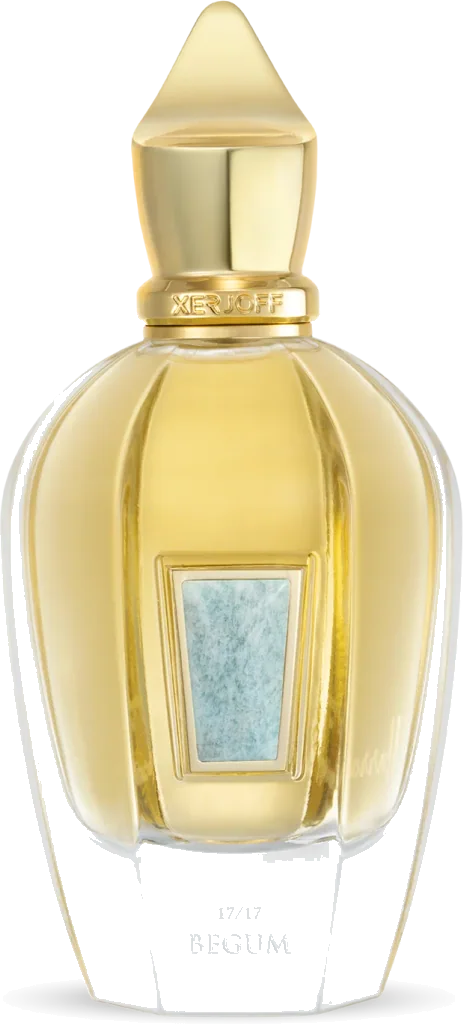
Xerjoff launched Begum in 2015 as part of its 17/17 Stone Label collection, composed by Chris Maurice, and it has stayed one of the hardest Xerjoff releases to actually buy. The brand sells it exclusively through its London boutique and Harrods, which means most people will never smell it on a department store shelf. At $572 for 100ml of pure parfum, it also sits near the top of the line. That combination of exclusivity and price is exactly why clones matter here.
What Does Xerjoff Begum Smell Like?
Begum opens with Calabrian bergamot, lemon, freesia and a red berry accent that reads fruity rather than sugary. This citrus phase is bright but short, maybe fifteen minutes on most skin.
The heart is where the fragrance earns its reputation. Damask rose and Bulgarian rose arrive together with jasmine sambac, iris, lilac, lily of the valley and ylang-ylang, and the effect is dense and creamy rather than green or soapy. Iris pulls the whole middle toward powder, which is why so many wearers describe Begum as a talc-like rose rather than a jammy or metallic one. If you dislike powdery florals, this is the point where you would check out.
The drydown softens further into vanilla, amber and musk over sandalwood, palisander rosewood, cedar and patchouli, with cypriol and oud providing structure instead of animalics. Anyone expecting a barnyard oud should recalibrate: the oud here is a supporting beam, not a headline. By hour four you are left with a warm, powdery rose-amber that stays remarkably smooth until the end.
Performance
Community ratings back up what the concentration promises. Parfumo users score Begum around 8.5 out of 10 for longevity across more than 200 votes, with sillage just behind that. In practical terms, expect eight to twelve hours on skin, with the first two to three hours projecting strongly enough that colleagues will notice without you overspraying. After that it sits within arm’s length but keeps going. Two sprays is plenty; this juice rewards restraint. The main caveat is heat, since the powdery sweetness can turn heavy above 25 degrees Celsius.
Best Clone Or Alternative
The Dua Brand’s That’s Amore is the obvious alternative because it exists specifically to copy Begum. Dua states outright that it was inspired by the Harrods exclusive and reproduces the entire note pyramid, from lemon and bergamot through both roses down to vanilla, amber and musk. You get a 34ml extrait de parfum for $75, which works out to roughly a tenth of the per-milliliter cost of the original.
How close is it? Structurally, very close: the citrus-to-powdered-rose-to-vanilla arc is all there. What the clone gives up is texture. Begum uses more natural materials, and its rose has a rounded, almost velvety quality that Dua’s version approximates rather than matches. Side by side, the original smells deeper and blends more seamlessly; on its own, That’s Amore delivers most of the experience for far less money. For anyone who cannot get to London, it is the sensible starting point, and an 85 percent similarity estimate feels fair.
When To Wear It
Begum fits cool and mild weather best: fall, winter and spring days, plus evenings. Its registered use cases are daily wear, evenings, special occasions and date nights, and the powdery warmth genuinely suits all four. For office wear, keep it to one spray and it behaves. Save heavier application for dinner, events and cold-weather daytime wear.
Who Should Buy It
Buy Begum if you love creamy rose-and-iris compositions, collect hard-to-find niche releases, or want a refined signature for cold months that nobody else in the room will be wearing. It also suits buyers who prefer elegant restraint over loud sweetness.
Who Should Skip It
Skip it if powder-heavy iris turns soapy or old-fashioned on your skin, if you want a bold oud statement, or if paying over $500 for a fragrance you cannot sample locally makes no sense for your budget. Hot-climate dwellers will rarely reach for it.
Final Verdict
Begum is one of Xerjoff’s most polished compositions: a comforting, talc-smooth rose chypre with genuine all-day performance and no rough edges. Its problems are availability and value, not quality. Sample a decant or start with Dua’s That’s Amore before committing to a bottle, and step up to the original only if the naturalness of that rose matters to you.