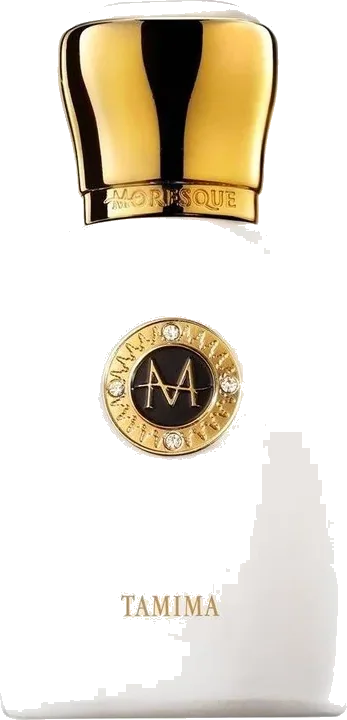
What Does Moresque Tamima Smell Like?
Tamima opens with neroli and Sicilian orange, but do not expect a bright citrus blast. Wearers consistently describe the fruit as muted, almost dusty, arriving already wrapped in herbs. Within minutes the eucalyptus takes over, backed by clary sage, and this is where the fragrance finds its identity: cool, green, camphorous, and slightly medicinal, like alpine air or a premium cough drop. Some noses also pick up a soft powderiness from the neroli and cashmeran right away.
The heart adds amber and keeps that odd but workable contrast going: refreshing eucalyptus floating over something warmer and creamier. In the drydown, cashmeran and bourbon vanilla smooth everything into a woody, musky-sweet base. The listed oud stays polite; almost nobody reports animalic smokiness, more a faint resinous edge that surfaces around hour three.
Community impressions split on sweetness. Some wearers get a clear creamy vanilla finish, while others insist Tamima reads entirely herbal and woody with no sugar at all. Both camps agree on one thing: this is a mature, serious composition, not a crowd-pleasing dessert. Parfumo users compare it to Xerjoff Alexandria II territory, an oriental with a strange fresh twist.
Performance
Performance is Tamima’s strongest argument. Longevity lands between 8 and 12 hours on skin for most wearers, and it clings to scarves and coats well past that. Projection sits at moderate to strong: you fill your own bubble for the first two to three hours, then it narrows to a noticeable close-range aura while remaining easy to detect all day. Several reviewers use the phrase beast mode without irony.
The flip side is that the opening projection can feel loud in tight indoor spaces, especially in warm weather when the eucalyptus turns sharper. Two sprays are plenty for office settings.
Best Clone Or Alternative
At €180 for 100ml direct from Moresque’s boutique, Tamima is priced like a luxury niche release, and even fans admit value is its weak point. The practical alternative is Perfume Parlour’s Princess - 1739, sold openly as inspired by Tamima for £22 per 50ml.
The clone mirrors the full pyramid: orange and neroli up top, eucalyptus, sage, and amber through the middle, then oud, cashmeran, and vanilla in the base. Expect roughly 85 percent of the experience. What the cheaper oil-forward formula tends to lose is the depth of the base and the way the original’s creaminess blooms after hour five. If you want to test whether the eucalyptus-and-vanilla idea works for you, buy the clone first. If you love it and want the richer, better-macerated version with a genuinely gorgeous white and gold bottle, the original justifies itself as a full-bottle purchase only after that test.
When To Wear It
Tamima fits fall, winter, and spring best. Cool air flatters the eucalyptus and lets the amber base develop properly. It works as a daily signature in cold months, shifts easily into evening wear, and feels special-occasion worthy thanks to its unusual profile. In summer heat it can turn sharp and medicinal, so go light or skip it.
Who Should Buy It
Buy Tamima if you want a woody oriental that smells unlike anything else in a crowded collection, if you value longevity over trend-chasing, or if herbal fragrances like sage and eucalyptus are already your thing. It suits anyone comfortable with a mature, contemplative scent that draws questions rather than compliments about smelling like everyone else.
Who Should Skip It
Skip it if you hate camphor or menthol-adjacent notes, since the eucalyptus never fully leaves. Skip it if you want a genuinely sweet vanilla gourmand despite the pyramid suggesting otherwise, or if the price would stretch your budget, because the clone covers the idea for far less.
Final Verdict
Tamima is a distinctive, long-lasting herbal-oriental with real craft behind it and one glaring weakness: the price-to-value ratio. Its cool eucalyptus over creamy woods is genuinely hard to find elsewhere, and the performance is near the top of its class. Sample it via Perfume Parlour’s Princess - 1739, then decide whether the original’s extra richness earns the €180.