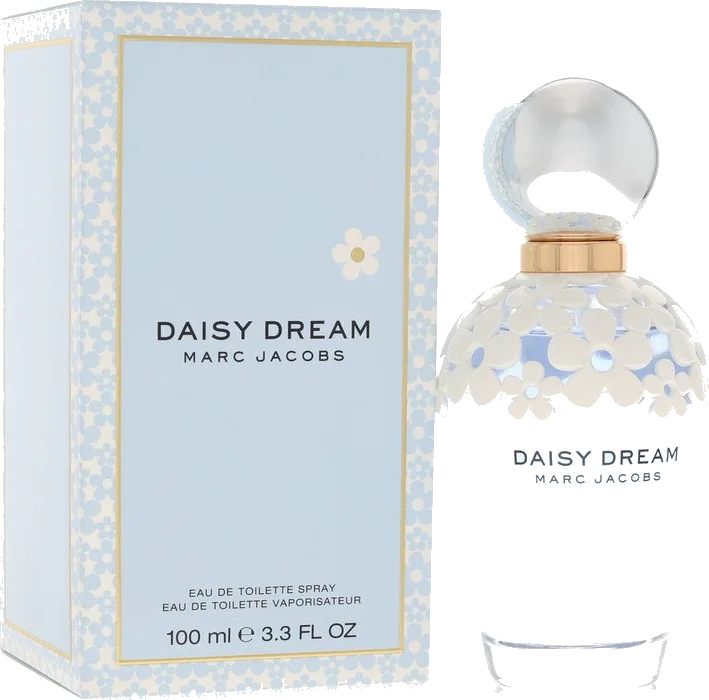
Marc Jacobs launched Daisy Dream in 2014 as the airy, fruit-forward sibling of its best-selling Daisy line, composed by Alberto Morillas with Ann Gottlieb. More than a decade later it still sells steadily, and it remains one of the easiest designer fragrances to wear. The catch is performance: this is a light eau de toilette that asks you to accept moderate longevity in exchange for a genuinely pleasant, crowd-pleasing scent.
What Does Marc Jacobs Daisy Dream Smell Like?
The opening is juicy and bright. Blackberry leads, backed by crisp pear and a snap of grapefruit that keeps the sweetness from going flat. Within the first half hour, the fruit recedes and a pale floral heart takes over: wisteria and jasmine wrapped around litchi, which adds a watery, slightly tropical roundness. This middle phase is the best part of the fragrance and lasts a few hours.
The drydown goes quiet and clean. Musk and white woods give it a soft, skin-like finish, and the listed coconut water note shows up more as a milky freshness than a beachy sunscreen accord. Overall it reads fruity, floral, fresh and lightly sweet with a woody base. If you know the original Daisy, think of this as its dreamier, softer cousin with less green edge and more fruit.
Performance
Daisy Dream lasts roughly 5 to 7 hours on most skin, which matches both editorial testing and the bulk of user reports. Projection is modest. You get arm’s length reach for the first hour or two, then it becomes a close-wear scent with a soft trail. Several reviewers flag this as the fragrance’s main weakness, and some report it fading even faster in heat or on dry skin.
That weakness is partly by design. As a daytime EDT aimed at offices and casual wear, it was tuned not to offend. Spray it on clothing or hair for extra staying power, keep a travel size handy, and temper expectations if you are used to modern extrait-strength releases.
Best Clone Or Alternative
Perfume Parlour’s Sleeping Lily For Women 1268 is the closest budget match. The UK oil house sells it explicitly as inspired by Daisy Dream, and its published pyramid mirrors the original almost exactly: blackberry, pear and grapefruit over litchi, jasmine and wisteria on musk, white wood and coconut water. A 50ml EDP spray runs about 18 pounds, against roughly $55 for 100ml of the real thing from discounters like FragranceX.
Oil-house recreations usually lose a little sparkle in the top notes and can smell slightly flatter in the first minutes, so treat it as a very close relative rather than an identical twin. For the price of one bottle of Daisy Dream you could buy several, which matters when the original itself needs midday touch-ups.
When To Wear It
Spring and summer are its home turf. It suits daily wear, casual outings, office days and beach trips alike. Daytime use dominates the consensus almost completely, and the soft sillage makes it a safe choice for planes, classrooms and shared workspaces. In cold weather it tends to disappear, so save it for warmer months or layer it over an unscented lotion.
Who Should Buy It
Buy it if you want an easy, feminine fruity floral for spring and summer days and value likability over distinctiveness. It works well as a first designer fragrance, a safe gift, or an office signature. Anyone who enjoys Chanel Chance Eau Tendre, Versace Bright Crystal or Miss Dior Blooming Bouquet will recognize the family immediately.
Who Should Skip It
Skip it if longevity is your top priority, since even fans admit it fades within a few hours. Skip it if you want a bold statement scent, a night-time fragrance, or something with depth for fall and winter. Lovers of gourmands, heavy whites or anything smoky will find it too polite.
Final Verdict
Daisy Dream is a well-made, pleasant fruity floral with a lovely litchi-jasmine heart and a genuinely weak engine. At around $55 for 100ml it is reasonably priced for a designer EDT, and the Sleeping Lily 1268 recreation makes the scent accessible for far less. If you love the profile, buy the original for the polish and the bottle. If you just want the vibe on a budget, the clone gets you most of the way there.