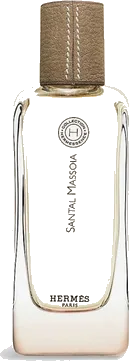
Hermès released Santal Massoia in 2011 as part of its Hermessence collection, and it remains perfumer Jean-Claude Ellena’s most direct statement on sandalwood. Priced around $330 for 100ml of eau de toilette, it is one of the few mainstream releases built on massoia bark, a wood that naturally smells like coconut milk. That single idea carries the whole composition, and it also explains both the fragrance’s charm and its most common complaint.
What Does Hermès Santal Massoia Smell Like?
The opening is a creamy, lactonic burst of milk and sugar over sandalwood, with massoia bark supplying a slightly earthy, coconut-adjacent creaminess. A touch of dried fruit adds quiet sweetness and faint florals keep the blend airy rather than dessert-like. Think of it less like a gourmand and more like sandalwood rendered in watercolor.
After the first hour, the sugar recedes and the heart settles into a smooth, powdery, milky sandalwood that sits close to the skin. This is where the fragrance spends most of its life. In the drydown, roughly from hour three onward, you are left with a faint whisper of sandalwood and powder, with just enough lactonic warmth to stay recognizable. The arc is simple and coherent, which is typical of Ellena’s minimalist style.
If you already know Diptyque’s Tam Dao or Tom Ford’s Santal 33, Santal Massoia occupies a softer, milkier space between them. There is no smoke, no leather, and no spice bomb here.
Performance
Performance is the recurring criticism. As an eau de toilette, expect roughly four to seven hours on skin, with many wearers reporting closer to the lower end of that range. Projection is intimate almost immediately. For the first 30 to 60 minutes you get a soft halo of creamy wood, then it becomes a personal skin scent that only someone standing very near will notice.
That restraint fits the collection’s philosophy, but at this price the cost per hour of noticeable wear is steep. Applying more or spraying clothing helps extend presence without distorting the scent. On fabric it can linger into the next day.
Best Clone Or Alternative
Dua Fragrances makes an explicit recreation called Massoia Resin, listed as inspired by Santal Massoia and built on the identical note set: milk, sandalwood, massoia resin, dried fruits, sugar, and floral notes. It costs $36 for 34ml of extrait strength, a fraction of the Hermès price per ml.
The two are recognizably the same idea, but they behave differently. Massoia Resin is denser and sweeter, leaning into the dried fruit and sugar, and its extrait concentration gives it noticeably better longevity and projection. What it gives up is Ellena’s transparency. Where the Hermès feels sheer and weightless, the Dua feels rich and almost chewy. If you want the closest experience to the original’s delicate style, only the original delivers it. If you mainly want the milky massoia-and-sandalwood effect with real staying power, the Dua covers about 85 percent of the experience for far less money. Note that it sells out frequently, so availability can be hit or miss.
When To Wear It
This is a cool-weather fragrance first and foremost. Fall and winter suit its warm, creamy depth best, and mild spring days work well too. Heat tends to flatten it and push the milkiness too far forward, so most reviewers advise against hot summer wear.
Because projection is so restrained, it is an excellent office and daily-wear choice where loud fragrances cause problems. It also works for date night precisely because of that closeness, though you will want several sprays to be noticed at all.
Who Should Buy It
Santal Massoia suits people who love subtle, creamy sandalwood scents and skin-like fragrances. If your favorites include Tam Dao, Santal 33, or anything described as lactonic, this belongs on your test list. Collectors of the Hermessence line will also appreciate it as one of the house’s most distinctive compositions.
Who Should Skip It
Skip it if you judge fragrances by longevity and projection, because it will disappoint at $330. Skip it if you dislike coconut or milky notes, since that character never leaves. And skip it if you want a bold gourmand; the sweetness here is a suggestion, not a statement.
Final Verdict
Santal Massoia is a beautiful, fleeting idea executed with real skill. The massoia and sandalwood pairing is genuinely uncommon and beautifully blended, but weak projection and modest longevity make the retail price hard to defend on pure practicality. Dedicated sandalwood enthusiasts and Hermessence collectors should try the original. Everyone else should start with Dua’s Massoia Resin, accept the extra sweetness, and decide later whether the original’s airiness justifies the upgrade.