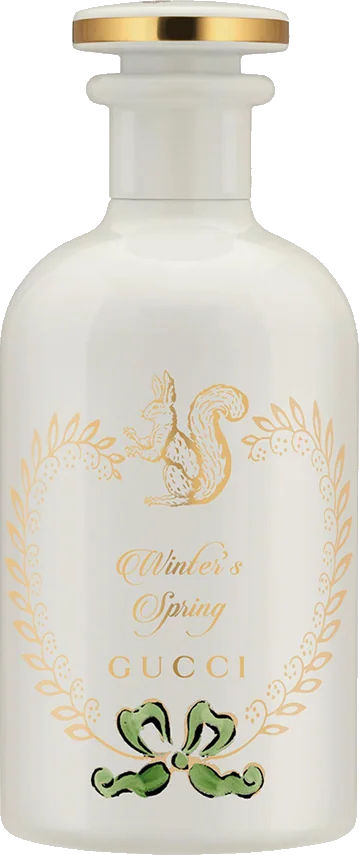
Gucci Winter’s Spring is one of the quietest releases in the brand’s high-end Alchemist’s Garden line, and that is exactly why it divides opinion. Launched in 2019 as a shared eau de parfum, it runs on a three-note skeleton of mimosa, pepper and musk. At roughly $395 for 100ml from Liberty London, it competes with serious niche pricing while smelling like something designed to whisper. Here is what it actually does on skin, how long it lasts, and whether Dua Brisk Breeze can stand in for it at a tenth of the price.
What Does Gucci Winter’s Spring Smell Like?
The opening is pure mimosa: a fluffy, pollen-dusted yellow floral with a faint honeyed sweetness and a green edge, like the fuzzy buds on a branch cut in late February. Within minutes, a restrained pepper note surfaces. It never reads as hot or sharp; think of the dry tickle of freshly ground peppercorn in the next room rather than spice on your tongue.
The drydown is where the fragrance settles into its real character. Clean white musk wraps the mimosa and pulls everything toward a powdery, almost cosmetic softness. Community accord data backs this up: powdery, musky, yellow floral, and sweet dominate, with green and fresh spicy facets underneath. There is no vanilla bomb, no amber, no wood. If you want complexity, look elsewhere. If you want a single beautiful idea executed smoothly, this delivers it. The transition from opening to base is gentle and linear by design, which some will find elegant and others will find one-dimensional for the money.
Performance
Performance is the weak point. User consensus puts longevity at roughly 3 to 6 hours, with the first hour carrying most of the projection before it collapses into a skin scent. On cold winter days it clings closer still; on mild spring mornings it blooms a little further but fades faster. This is an intimate fragrance you will smell on your own wrists more than anyone else will smell on you.
For an office or close-contact setting, the low projection is arguably a feature. For anyone expecting a $395 bottle to fill a room, it will disappoint. Plan on 3 to 4 sprays and midday touch-ups if you want it to last through an afternoon.
Best Clone Or Alternative
Dua Brisk Breeze is the obvious alternative, and Dua openly markets it as an interpretation of Winter’s Spring. It uses the identical mimosa, pepper and musk trio, sold as a 34ml extrait de parfum at $36 against roughly $330 to $395 for 100ml of the original. Dua’s version leans slightly more powdery, adding an almond flour nuance to the mimosa, and the higher concentration helps it hold on skin. The main caveats are availability and finish: Brisk Breeze was shown as sold out on theduabrand.com when we checked, and Dua’s juice rarely matches the smooth blending of Gucci’s perfumers. Still, at 85 percent similarity for a tenth of the cost, it is the rational first purchase. Buy the original if you fall in love with the scent and want the superior texture and the heavy glass bottle.
When To Wear It
Despite the name, this works in two windows. In early spring it fits the season literally, matching blooming mimosa trees with cool air. Through winter, its warm powdery softness works as a bright counterpoint to heavy ambers and gourmands. It suits daily wear, office settings, and casual daytime plans. Skip it for evenings out, cold-weather nights where you need presence, or any situation where you want to be noticed across a room.
Who Should Buy It
Buy it if you love realistic mimosa and powdery floral musks, work in close quarters where a quiet scent is a virtue, and appreciate minimalist compositions. Fans of soft, clean, slightly honeyed florals that never turn sweet will get regular use from it.
Who Should Skip It
Skip it if you judge fragrances by projection and longevity per dollar, prefer complex evolutions, or dislike powder. Anyone balking at the price should try Dua Brisk Breeze first.
Final Verdict
Winter’s Spring is a lovely, narrow fragrance with honest weaknesses: modest staying power, intimate reach, and a steep asking price. As a scent, it earns a solid recommendation; as a value proposition, it does not, unless you catch it discounted at discounter prices. Sample it, then decide whether the original’s polish justifies the premium over a very capable $36 clone.