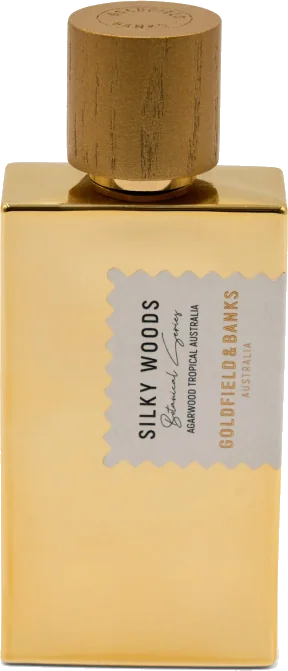
What Does Goldfield & Banks Silky Woods Smell Like?
Silky Woods is built on a simple idea: take agarwood, strip out everything harsh, and wrap it in spice, vanilla, and clean leather. The opening is all golden heat. Saffron and Ceylon cinnamon arrive together within the first minutes, giving a dry, slightly sweet spiciness that some wearers compare to a spiced dessert without any fruit or chocolate. There is no citrus blast here, which makes the start feel unusual compared with most designer releases.
After 20 to 40 minutes the heart takes over, and this is where the name starts to make sense. Suede and smooth oud create a soft, almost powdery leather effect, while Madagascar ylang-ylang and jasmine add a creamy floral sweetness that keeps the composition from turning austere. The oud is polished and approachable, closer to refined wood than anything animalic, so people who avoid oud-heavy perfumes can still wear this comfortably.
The drydown is the best part. Tahitian vanilla and Australian sandalwood melt into tobacco leaf, musk, and olibanum, producing a milky, faintly smoky skin scent that lingers close to the body. Wearing it through a full day, you mostly notice the vanilla-sandalwood-tobacco trio after hour three, and it stays smooth rather than turning sharp.
Performance
Silky Woods performs like a moderate Eau de Parfum, not a beast. Expect roughly 6 to 8 hours on skin, with the first two hours giving noticeable arm’s-length projection before the scent pulls inward. Community wear reports and independent reviews consistently land in that same range, so the numbers are well supported. On fabric it lasts considerably longer, often into the next day on a scarf or jacket collar.
The restrained projection cuts both ways. It makes Silky Woods safe for offices, dinners, and close-contact settings, but buyers paying $240 for a 100ml bottle sometimes expect more presence than it delivers. Applying 4 to 6 sprays instead of 2 solves most of the complaints about it being too quiet.
Best Clone Or Alternative
Perfume Parlour Velvet Woods 2106 is the obvious budget route. Perfume Parlour lists it explicitly as being similar to Silky Woods and publishes a matching notes pyramid, from the saffron and cinnamon opening through the suede-and-oud heart down to the vanilla, sandalwood, tobacco, and olibanum base. At about $13 for an oil-based format against $240 for the original, the price gap is enormous.
As a concentrated perfume oil, Velvet Woods sits closer to the skin and typically lasts a shorter time per application, so reapplication is part of the deal. The original still wins on raw material quality, especially the natural-feeling sandalwood and the seamless blending in the base. If you want to test whether the Silky Woods style suits you, buy the clone first. If you find yourself reaching for it constantly, then the full bottle makes sense.
When To Wear It
Silky Woods is a cool-weather fragrance. Fall and winter evenings are its strongest setting, and it also works well on crisp spring days when the sun has not warmed things up much. In real summer heat the cinnamon and vanilla can turn heavy and cloying. Occasions that fit best are date nights, dinners, special events, and any evening where a warm, sweet signature feels right. It works as a cold-day daily scent if your workplace tolerates noticeable fragrance.
Who Should Buy It
Buy Silky Woods if you love sweet woody scents with a gourmand edge but want something smoother and more refined than typical sugary designer releases. It suits fans of vanilla-forward niche perfumes who want a touch of leather and smoke underneath, and it works across genders without reading masculine or feminine.
Who Should Skip It
Skip it if you want loud projection, fresh summer scents, or true dark oud, because none of those describe this composition. Anyone sensitive to cinnamon-heavy openings should sample first. And if $240 for 100ml does not fit the budget, the $13 clone covers the same idea at a fraction of the cost.
Final Verdict
Silky Woods earns its reputation on the blend, not the power. The saffron-to-vanilla progression is genuinely smooth, and the drydown is one of the more comfortable sweet-woody finishes in this price bracket. Its weaknesses are modest projection, a high price, and limited summer use. Sample it, try Velvet Woods 2106 alongside it, and decide whether the original’s polish justifies the premium.